
A 500 Year Old Engagement Ring History and Why It Still Matters Today
Most people assume engagement rings are a Victorian invention. The actual engagement ring history goes back to around 3000 BC, which is humbling when you sit with it.
The Egyptians had them. The Romans had them. And the diamond? That part is far more recent than almost anyone realizes, and the story of how it got there is genuinely strange.
The Ancient Origins of the Engagement Ring
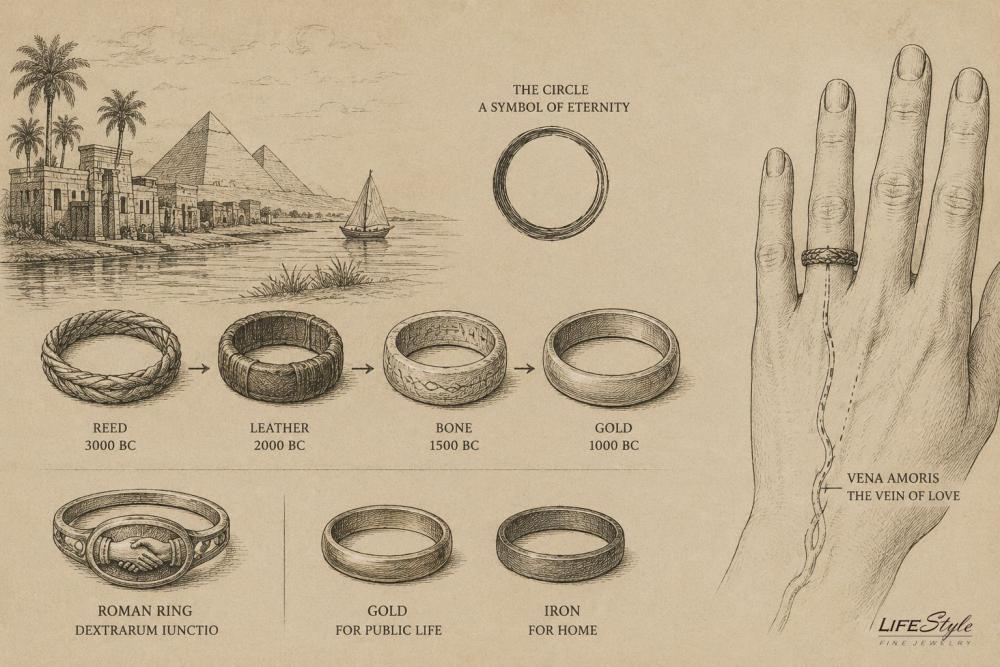
Start at the Nile, around 3000 BC. Ancient Egyptians were braiding small rings from reeds and papyrus and exchanging them as tokens of promise. The circle meant eternity to them. No beginning, no end.
They wore these on the fourth finger of the left hand because they believed that finger held a vein running directly to the heart. They called it the vena amoris. The vein of love.
They were wrong about the anatomy, obviously. But the idea was beautiful enough that it survived being wrong by several thousand years.
As Egyptian wealth grew, so did the materials. Reed became leather, leather became bone, and bone eventually became gold. The circle and the finger both stayed the same. What began as a promise in woven grass became one in precious metal, and the underlying gesture never really changed.
Rome added its own layer. Roman brides received two rings: gold for public life, iron for home. The iron wasn't a downgrade. It was the point. Iron holds its shape. It doesn't soften under pressure. Many Roman rings also featured two clasped right hands, a motif called dextrarum iunctio, meaning the joining of right hands.
Worth noting: there isn't a diamond anywhere in any of this. For thousands of years, the ring itself carried all the meaning. That changed, but not until much later.
When Did Diamond Rings Become Popular and Why?
The direct answer to when did diamond rings become popular is 1477.
Archduke Maximilian of Austria proposed to Mary of Burgundy that year with a ring set with small flat diamonds arranged into the letter M. First documented diamond engagement ring in history.
Because Maximilian was royalty, and royalty was the template everyone aspired to, wealthy Europeans across the continent quickly followed.
But the trend stayed at the top of the social pyramid for a long time. Through the 1700s and most of the 1800s, the average engagement ring carried a ruby, a sapphire, or plain gold. Diamonds were genuinely expensive and genuinely rare. They belonged to the aristocracy, not to ordinary people.
1866 changed the supply side. Massive deposits were found in South Africa. Prices dropped. Diamonds became theoretically accessible to a wider population.
The Campaign That Made Diamonds Feel Essential
But cheaper supply doesn't create cultural ritual on its own. Someone needed to change what people actually believed about diamonds. That intervention came from a mining company, and it became one of the most effective pieces of persuasion in commercial history.
De Beers controlled most of the world's diamond supply by the mid twentieth century and they had a serious problem. Demand had collapsed during the Great Depression and never recovered properly. They brought in an American agency, N.W. Ayer, with a brief that boiled down to: don't sell a product, change how people feel about it.
Frances Gerety, a copywriter, wrote the line in 1947. De beers a diamond is forever. Four words that became one of the most recognized advertising slogans ever written.

What made it work was the psychology embedded in it. The line told people a diamond ring wasn't an asset to liquidate when money got difficult. It was a feeling in physical form. You don't sell feelings.
The campaign also introduced the idea that a man should spend a month's salary on a ring, later revised to two months, and placed diamonds on the fingers of film stars that millions of people admired and imitated.
By 1951, jewelers reported that women without diamond rings didn't feel properly engaged. By the early 1980s, over 80 percent of engagement rings sold in America included a diamond. In 1940 that number had been around 10 percent.
The history of diamond engagement rings as most people recognize it is, in honest terms, largely the product of one advertising idea hitting exactly the right moment.
What Does a Diamond Ring Really Mean?
Set all of that aside. The diamond ring meaning that holds up underneath the advertising is more layered than people expect.
The word diamond traces back to the Greek adamas, meaning roughly unconquerable. Ancient Greeks believed the stone was indestructible and tied it to divine strength. Warriors carried uncut diamonds into battle.
In ancient India they were placed in the eyes of sacred statues because people believed the stone could perceive things human eyes couldn't. Across cultures with no connection to each other, diamonds were consistently treated as a material that meant something lasting, not just something beautiful.
Physically, that reputation holds up. Diamond is the hardest naturally occurring substance on Earth. A 10 on the Mohs scale. The only thing that scratches a diamond is another diamond. That's not a story anyone invented. That's just chemistry.
The diamond ring significance, looked at this way, comes from something older than any campaign. People reached for the hardest thing available to say the most serious thing they knew how to say. The stone became shorthand for: this is what I believe this is made of.
One more thing. A well cut diamond doesn't hide its flaws. Under enough light and magnification any internal imperfection becomes visible. There's something quietly honest in that, even if most people never consciously think about it.
How LifestyleGCC Brings That Legacy to Every Ring
Knowing the full history of diamond engagement rings changes how a ring in a display case looks. It stops being a product and becomes the most recent entry in something five thousand years old.
LifestyleGCC has been operating across the UAE and Bahrain since 1997 and in nearly three decades they've built their name on understanding that weight.

Their engagement ring collection runs from classic solitaires in 18k white gold to contemporary twin diamond rings made for couples, all crafted from certified diamonds and held to a quality standard that takes the stone and its story seriously.
Every gemstone comes from trusted suppliers and goes through strict checks before it ends up in any piece. The in house design team covers a wide range of styles, from quiet and minimal to bold and modern.
With 24 outlets across major malls in the UAE and Bahrain, the experience feels less like completing a transaction and more like making a real decision with people who understand what it represents.
Choosing a Diamond Ring Today

The cut is the most important factor and the most overlooked one. A well cut stone catches light in a way that has nothing to do with its size.
Two diamonds of identical carat weight can look completely different on a finger depending on how they were cut. Start here before anything else.
Setting shapes the whole personality of the piece. Solitaire settings are clean and direct. Halo settings surround the center stone with smaller diamonds and make the ring appear larger. Three stone settings represent past, present, and future. Some people find that meaningful. Others find it a bit literal. Worth knowing which before you start looking.
Metal is personal. Platinum and white gold remain the most popular choices. Yellow gold has made a genuine comeback in vintage leaning designs. Rose gold appeals to people who want something warm and unexpected.
And always buy certified. Documentation from a recognized gemological body confirms the cut, color, clarity, and carat weight. It removes guesswork and protects a purchase that matters.
Conclusion
The engagement ring history that started with braided reeds on the Nile, moved through the courts of Rome, arrived in the diamond tradition in 1477, and got its most recent chapter from a four word slogan in 1947 is still being added to.
Every ring given in a genuine moment between two people is another line in a record five thousand years long.
The diamond earned its place in that story for real reasons alongside the commercial ones. People kept reaching for the most enduring thing available to represent something they didn't have enough words for. That instinct didn't start with an ad campaign. The campaign just knew how to use it.